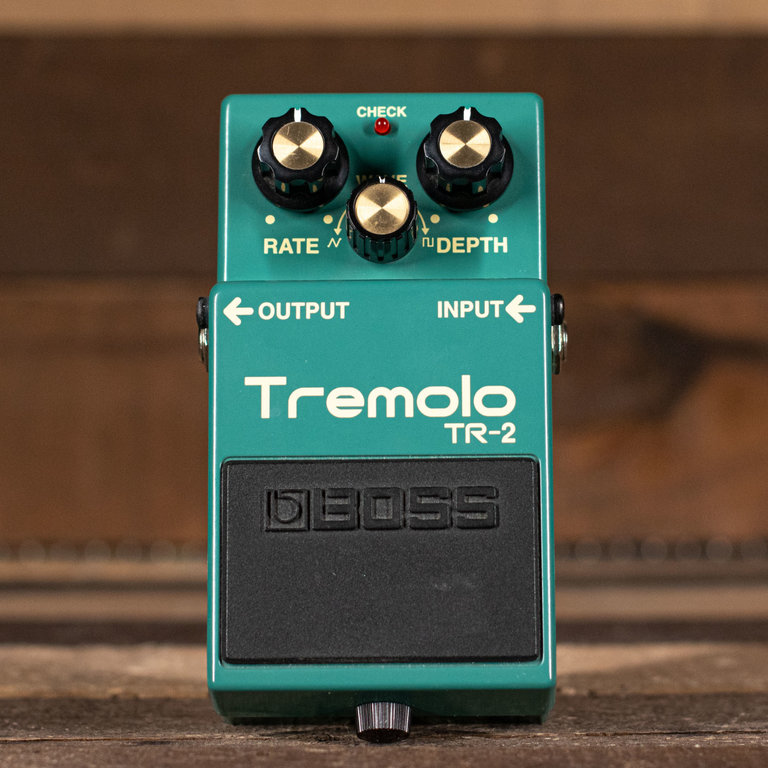
Tremolo is the oldest effect there is — it was built into amps before pedals existed. Boss put it in a compact box you could drop off a building, and it became the default. The TR-2 is not exciting. It’s not supposed to be. It’s the tremolo you buy when you want tremolo and you want to stop thinking about it. That’s a compliment, mostly.
How It Sounds
Three knobs — Rate, Wave, Depth. Turn Wave one way and it’s a smooth, round, vintage-amp throb; turn it the other and it hardens into a choppy square-wave stutter. Everything from a lazy surf shimmer to a helicopter is in there. The build is the usual Boss situation: it will work in the rain, get stepped on for twenty years, and never once ask you how you’re doing.
From the Bench
Now the asterisk, because everyone who’s owned one knows it. The TR-2 drops a little volume and low end when you kick it on. There’s an entire cottage industry of TR-2 mods that exist purely to fix this. It’s not a dealbreaker — you nudge your levels and move on — but for a company this size, on a pedal this old, it’s the one thing they never quite addressed.
Bottom Line
The TR-2 grades a 27 out of 36 — Master. Excellent, dependable, does the job, will be working long after we’re gone. Not higher, because of that volume dip — the one thing you’d expect the institution to have solved by now. But it’s the institution for a reason. Buy it and you’ll never worry about it again, which is worth something.
Built like a tank. Priced like a Boss. Read on for who beat it.
More info: the TR-2 at Boss — straight from the maker.
Built something too. Fretsmith — the reference I actually use on the bench: verified specs, string tension, setup calculators. No accounts, no subscriptions, one-time purchase. The pedals plug into a guitar. Somebody has to know what the guitar needs.
The Mixtape
One email a week. The sharpest review, one buried gem, zero spam and zero sponsored garbage.